BlogHow does electricity reache your home?
Nowadays, it is impossible to imagine our lives without appliances, machines, technologies, or other things that are powered by electricity. The world would not be able to function properly if electricity was not available when it is needed. For example, schools, hospitals, offices, homes, and industries rely heavily on electricity to operate.
However, what we don’t often think about is, where does that electricity actually come from? And how does it get from where it’s made into our homes and businesses?
Multiple stages are involved before electricity is delivered safely and efficiently to where it is needed.
It is important to note that Alternating Current (AC) at frequency 50 / 60 Hz (depending on the country) is used in power systems instead of Direct Current (DC). There are high-voltage DC (HVDC) links that are used to interconnect different countries and exchange power between each other.
Stage 1 - Generation
Electricity is generated through the utilisation of two types of energy sources:
Renewable energy source
Energy is derived from natural sources that are sustainable and replenished at a higher rate than they are consumed.
They are generally cleaner, greener, and cheaper.
They are sometimes referred to as alternative energy sources but this is not always the case.
Non-renewable energy source
Fossil fuels (coal, oil, gas, etc.) take hundreds of millions of years to form. When they are burned to produce energy, harmful greenhouse gas emissions, such as carbon dioxide are emitted into the atmosphere
They are also sometimes referred to as conventional energy sources.
Once the electricity has been created/generated, the power producers/generators then sell it on the wholesale market to energy suppliers.
Stage 2: Transmission – sending electricity around the country
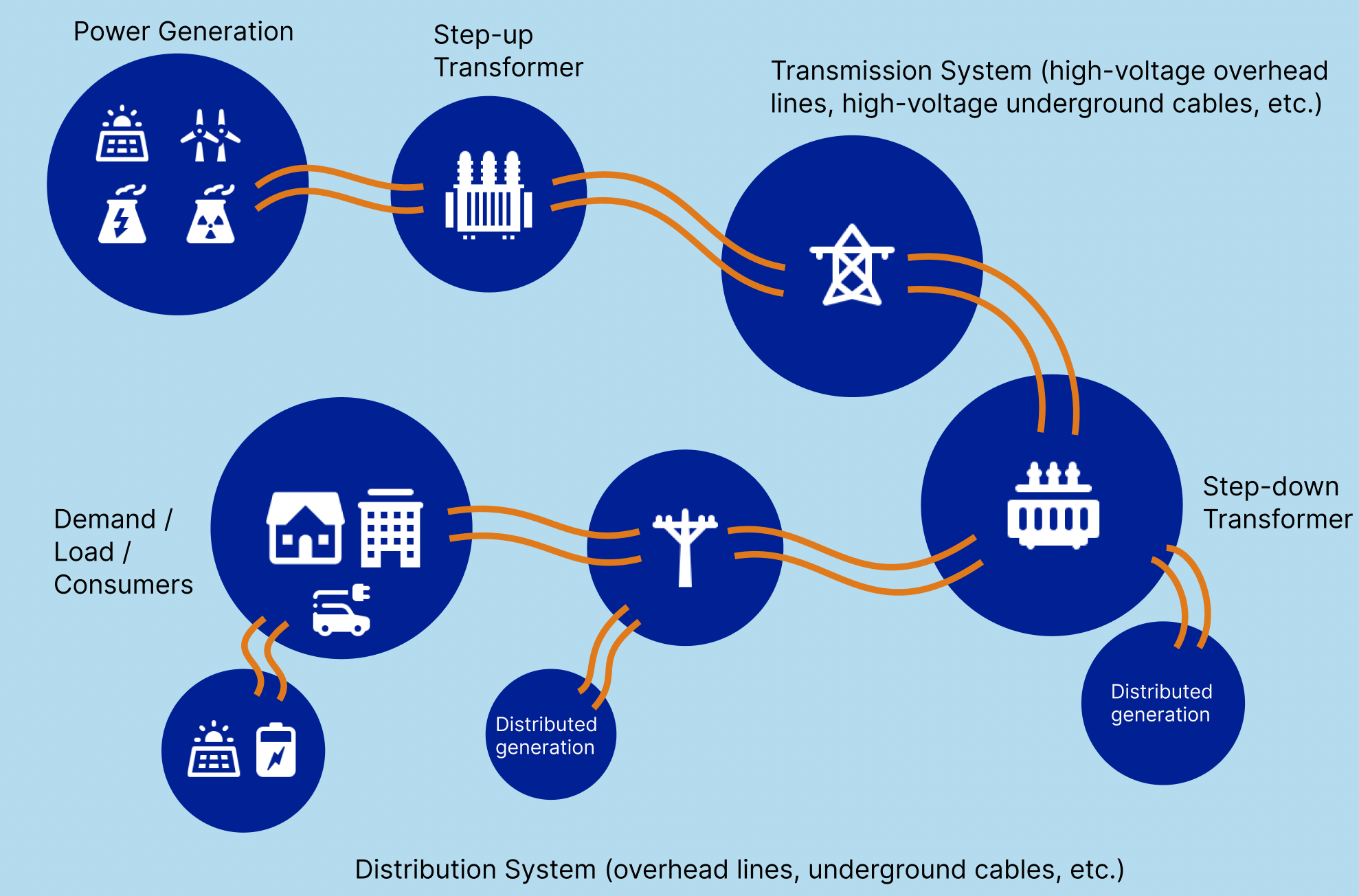
Generated electricity needs to be delivered safely and efficiently over long distances to the consumer load centres that are spread over wide area. This is achieved with the help of an electricity transmission network which consists of big pylons, high-voltage overhead lines, underground cables, substations, and other equipment.
The easy analogy for a transmission network is a motorway. It carries/transmits electricity at high voltage across the country from where it’s generated to where it can be distributed to our homes and businesses.
The transmission network operates at the highest voltage levels (typically, 230 kV and above). The reason for using higher voltages is to efficiently, reliably, and cost-effectively transfer power over long distances by minimising energy losses in the overhead lines and cables, and by reducing infrastructure costs.
Stage 3: Balancing the grid – making sure electricity is there when you need it
One of the important aspects is to make sure that the system is balanced. Consumption of electricity at different places at different times is not the same. Therefore, it is the job of the Electricity System Operator to move electricity around the network second by second to ensure that the right amount of electricity is where it’s needed when it’s needed – always keeping supply and demand in perfect balance.
Stage 4: Distribution – how electricity gets to your home
The distribution system represents the final stage in the transfer of power to the individual customers. Similar analogy to the transmission network, distribution networks are like local roads, connecting motorways with communities to deliver electricity to our homes and businesses.
Because electricity from the transmission network is of a high voltage, distribution networks must first lower the voltage, via a distribution substation, to make it safe to use in our homes.
Distribution network operators manage the poles, pylons, cables, and substations in your local region.
Stage 5: Energy suppliers – who send you your bill
Your electricity bill is sent to you by your energy supplier. Suppliers buy energy from generators on the wholesale market and sell it on to you, their customer. They set the tariff for the electricity you use and you’re free to choose any supplier you like.